I haven’t written in a while. Not because I had nothing to say, but because I had too much.
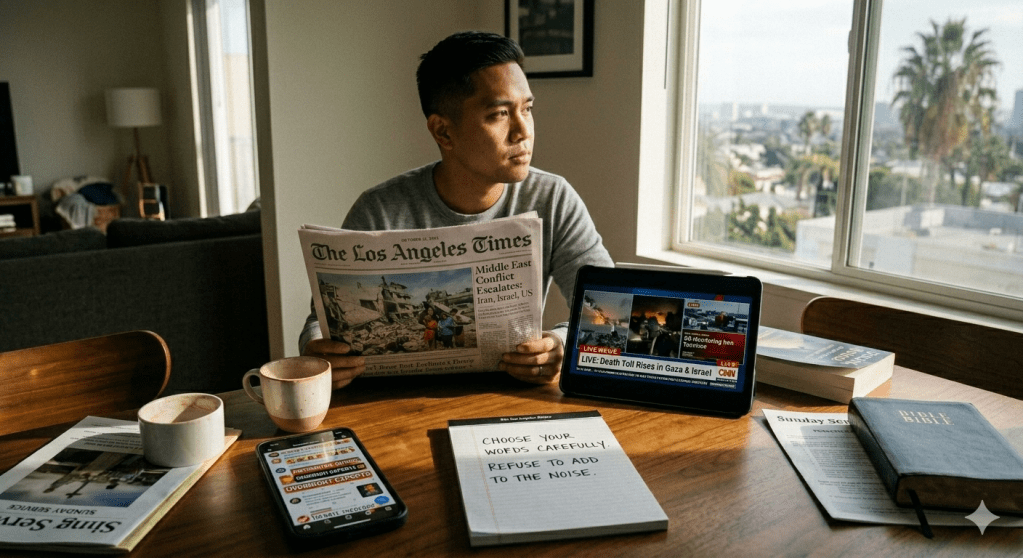
Yesterday began as a lazy Saturday. Coffee. Quiet. The slow comfort of routine. Then I opened the news and felt that familiar jolt — the kind that turns an ordinary morning into something charged and restless. As a five-year subscriber to the Los Angeles Times since moving to Los Angeles, I’ve made a habit of starting my day with headlines. But this time, the headlines refused to let me go.
Reports of escalating conflict involving Israel, the United States, and Iran pulled me in. What began as casual reading became an all-day immersion: live updates, analysis, commentary, history lessons on Iran’s supreme leaders, deep dives into decades of tension between Washington and Tehran. I watched, read, and rewatched. By Sunday morning, instead of preparing for church or opening my Bible, I was still glued to the steady climb of confirmed casualties — civilians, children among them.
War has a way of rearranging priorities, even from thousands of miles away.
So what is my take?
I am a Filipino living in the United States. I am not a policymaker. I am not a military strategist. I am not in any room where decisions of consequence are made. Realistically, there is little I can do to halt a conflict unfolding across oceans. Prayer may feel small to some, but for many of us, it is the only sincere offering we have.
Beyond that, there is something else we can do — something immediate and entirely within our control: we can be sensitive to one another.
In times of war, something curious happens. Overnight, we all become experts. We speak with certainty that rivals seasoned analysts. We debate as though we have negotiated treaties or studied geopolitics for decades. In a democracy, yes, we have the right to speak. But having a voice does not make us authorities. And volume does not equal truth.
Social media rewards outrage. Conversations become contests. Emotions overpower evidence. We talk to win, not to understand. We declare positions as if they are doctrine. And in doing so, we forget that behind every headline are people who are grieving — families who do not have the luxury of abstract debate.
I would rather read a carefully researched column than argue in circles. I would rather listen than perform certainty. There is humility in admitting we do not fully understand the complexity of war. There is wisdom in recognizing that strong feelings are not the same as informed conclusions.
I am against war — not because it is politically fashionable to say so, but because war guarantees suffering. It ensures that civilians, especially children, will pay for decisions they never made. It drags peace-loving people into nightmares they did not choose. It forces ordinary individuals — people like me — to watch in horror, grateful only that the bombs are not falling in our own neighborhoods.
That gratitude is uncomfortable. It comes with the realization that safety, for many of us, is an accident of geography.
We cannot all be diplomats. We cannot all be activists. Not everyone is called to the streets in protest. But every one of us participates in conversations — at work, at dinner tables, online. And in those spaces, our words matter.
Be mindful. Be careful. Be compassionate.
When casualties are rising and parents are burying children, the least we can do is speak with restraint. In an age where outrage travels faster than facts, sensitivity is not weakness. It is decency.
If we cannot stop the war, let us at least refuse to add to the noise.
 Angelino AF (Asian Flavor)
Leave a comment