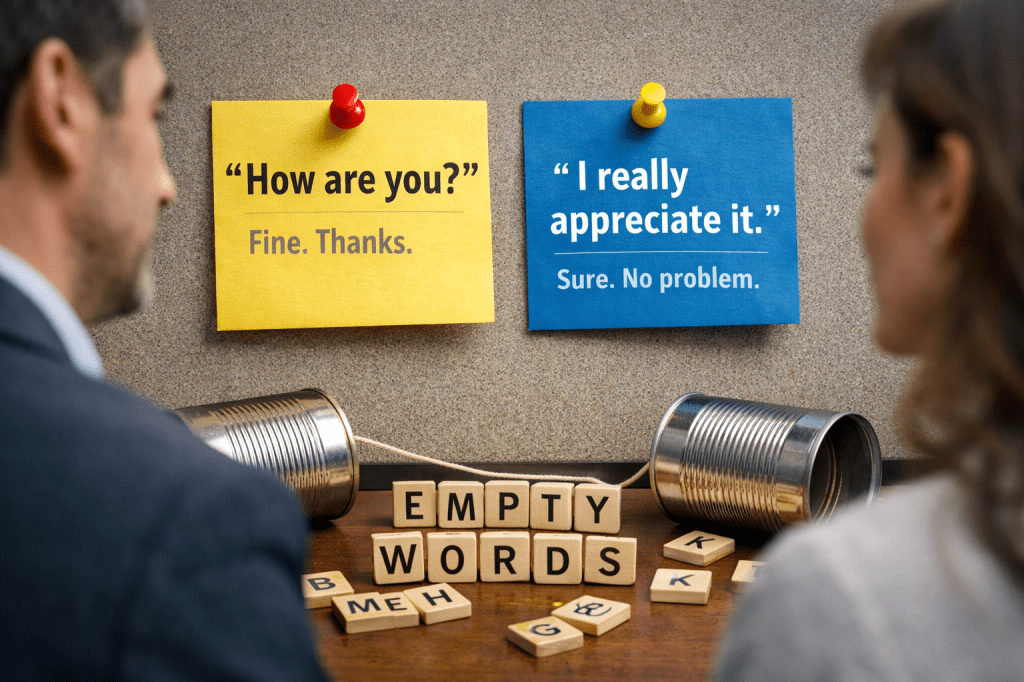
One thing I noticed when I first came to the United States is how casually people use the phrases “How are you?” and “I really appreciate it.” They’re everywhere—so common that they’ve almost lost their meaning.
When someone first asked me, “How are you?” I took the question seriously. I would pause for a moment and reflect on how I was actually feeling. Then I would answer honestly. And when I asked the same question back, I expected the other person to do the same.
But most of the time, the response was automatic: “I’m good!” And just like that, the conversation moved on. No reflection. No real answer. Just a reflex.
It didn’t take long for me to realize that here, “How are you?” often isn’t a question at all—it’s just a greeting.
That’s what puzzles me. How are you is not the same as hello. It’s a question. It asks about someone’s well-being, their state of mind, their life at that moment. Yet people say it without expecting an answer and respond to it without actually giving one.
The same thing happens with “I really appreciate it.” People say it after the smallest transactions—after receiving change from a cashier, after an Uber ride, after a quick favor on the phone. It has become a polite punctuation mark at the end of an interaction. But sometimes it feels less like gratitude and more like habit.
And it makes me wonder: do we still mean what we say? Or are we just repeating phrases because that’s what everyone else does?
In my culture, “How are you?” is a real question. When we ask it, we genuinely want to know how someone is doing. And when we say “I really appreciate it,” we mean it with intention, not as a default response.
Language should connect people, not just fill silence.
So maybe the next time we ask someone “How are you?” we should be ready to actually listen. And when we say “I really appreciate it,” we should make sure we truly do.
Because words lose their value the moment we stop meaning them.
 Angelino AF (Asian Flavor)
Leave a comment