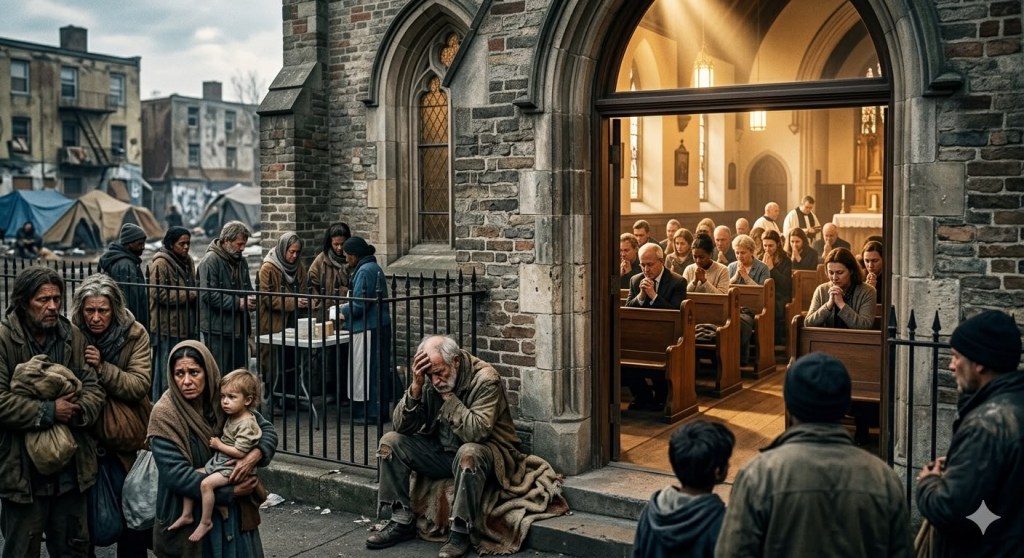
When I was in theological school, one of our professors asked a question that stayed with me for years:
“Who do you think receives more credit in heaven — someone who goes to church on a Sunday, or someone who spends that Sunday helping people, such as feeding the hungry?”
What seemed like a simple question quickly turned into a deep debate. It eventually opened up larger discussions about society, government, politics, morality, and faith itself.
More questions followed:
“Is it enough to lock yourself in your room, pray, and ask God for help while ignoring the problems of society?”
“Is it morally right to turn your back on the suffering of the community while continuing to attend church and simply pray?”
“When we talk about serving God, does that only mean serving within our own circle of believers? Or does it also mean stepping outside our comfort zones to serve those who may not even share our faith?”
The more we discussed these questions, the more I realized how transactional society has become. We often give because we expect something in return. And because human beings naturally desire control, we sometimes project that mindset onto our faith.
We begin treating spirituality like a merit system.
If we go to church every Sunday, we think we earn a point in heaven. If we pray every day, we think we earn another. We try to measure righteousness through rituals and actions, almost as if we can somehow control how God responds to us. In doing so, we create an image of God and heaven based on our own limited understanding.
The danger begins when we convince ourselves that our system of belief is the only correct one, while all others are wrong. That is when religion turns into pride. We become like the Pharisees and Sadducees in the Bible — quick to condemn those who do not follow what we follow.
Through years of studying theology and through my experiences in mission work, meeting people from all walks of life, I came to understand something important:
Pleasing God is not about collecting spiritual points.
I came to understand that many of our beliefs were handed down through generations, shaped by the culture, struggles, and realities of their time. Because of that, faith should not fear questions. It is okay to think critically. It is okay to ask why instead of blindly following simply because someone said so.
I also came to understand that we cannot manipulate God through religious performance. No matter how many times we pray in a day, it does not make us more righteous than others, nor does it place God under our command.
And perhaps most importantly, I realized that people love debating about God as if He needs defending. But in reality, God does not need our defense — He is God. The Almighty. The Omnipotent. The Alpha and the Omega. Why would He need us to protect Him? If anything, He is the one protecting and sustaining us.
So going back to that original question:
Who receives more credit in heaven — the person who goes to church on Sunday, or the person who spends that Sunday helping the hungry and serving those in need?
For me, the answer will always be:
“Whatever you did for one of the least of these brothers and sisters of mine, you did for me.”
FAITH WITHOUT WORKS IS DEAD! James 2:26


Leave a Reply